Featured Development: Othello Housing Authority - Rocky Point
/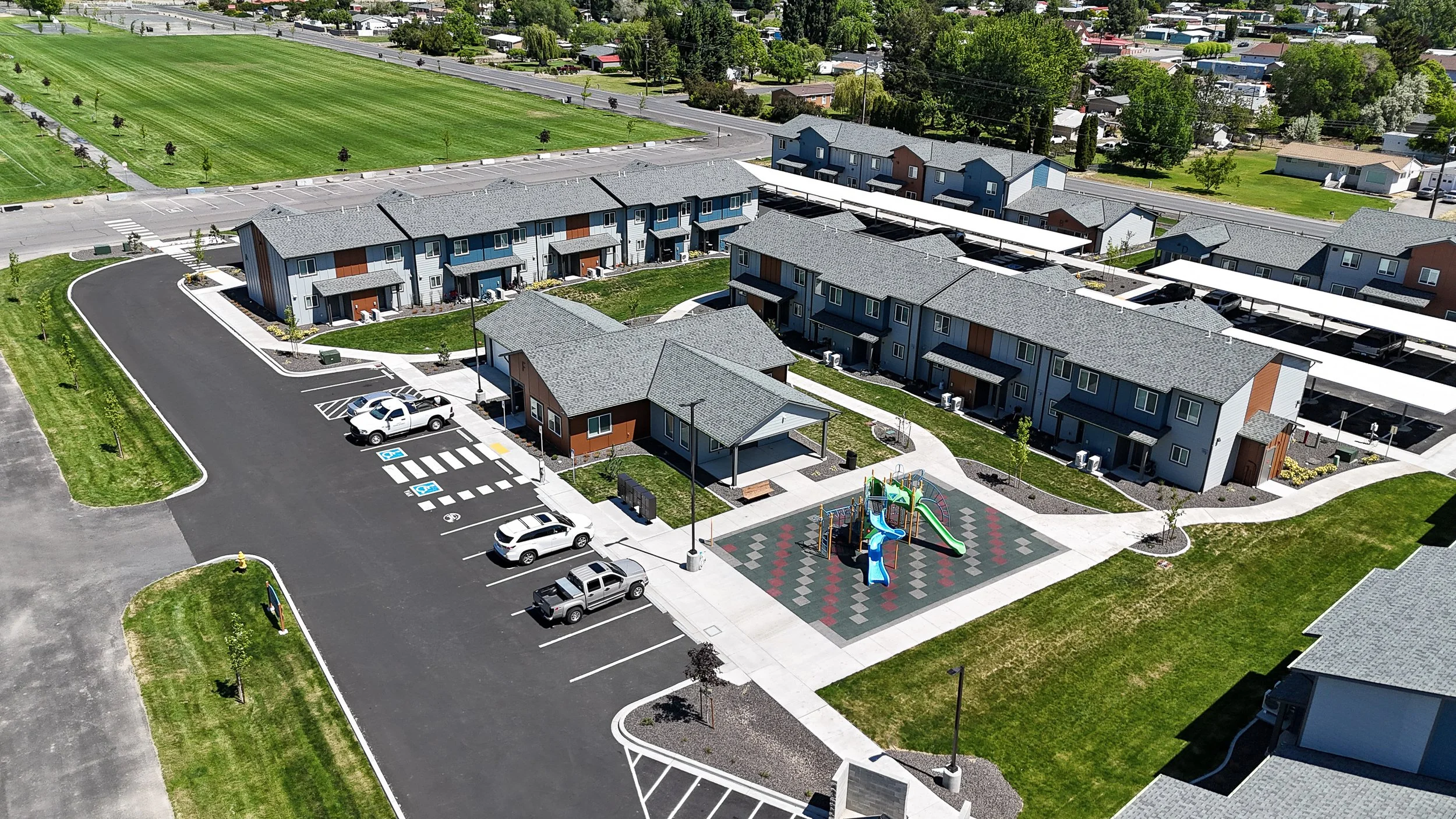
Image courtesy of M.C. Lundgren
For Cristina Alvarez Ruiz, farmworker housing is not just merely a good thing to have – it’s essential. The Senior Housing Developer at ORFH grew up with a love of the land; her family has farmed in the Yakima Valley for more than 50 years. So, when the opportunity came up to make sure that more stable housing for farmworkers and their families was built, she jumped right in with both feet.
“I personally have a passion – for farmworkers, for agriculture, for basically what feeds our community, or provides food on our table. And I think that’s what led me to ORFH and ultimately, I think that’s what Marty [Miller, Executive Director of ORFH] just thought - put her on all these farmworker projects - because she’s passionate about farming, about farmworkers, about agriculture,” said Alvarez Ruiz.
The latest such project, the Rocky Point housing development in Othello, arrived on Alvarez Ruiz’s radar before the Coronavirus pandemic. In 2019, the Othello Housing Authority was looking for their next affordable housing build site. The owner of a 10-acre plot of land approached them – are you interested in buying? Angelina Gomez, the former Executive Director of the Othello Housing Authority, moved quickly on the prospect. But despite the enthusiasm, the deal didn’t happen quite as planned.
“Back in 2019 we were talking to the landowner of this property, and he decided that, you know, he didn’t like the terms that we had so we dropped it,” said Gomez.
“Well, the appraisal came in lower than what the purchase and sale agreement was at,” said Alvarez Ruiz. “And we had to go back to the owner, or the seller, and say sorry but as a Housing Authority they cannot pay more than what it’s appraised for.”
After the deal fell through, plans stalled but communications between ORFH and the Othello Housing Authority continued. Then, in 2020, after the pandemic moved everyone to home offices, the project caught a break.
“Fast forward six months, the seller comes back and says, ‘Hey the [other] deal is off the table, are you still interested?’ And we said if you’re interested in selling, at the appraised price, yes,” said Alvarez Ruiz, adding, “And that was such a whirlwind because then when he came back, he said we need to close like, by tomorrow. And we were scrounging around trying to secure our financing.”
As with most affordable housing developments, funding came from multiple sources. For the land, ORFH and the OHA utilized what is known as a LAP Loan; Land Acquisition Program, offered through the Washington State Housing Finance Commission.
But as anyone in development could tell you, closing on the site is just the first step in a years-long process.
“After we had secured the site then we said we need to go out for the actual funding for the construction and development of the site,” said Alvarez Ruiz.
Years of challenges, obstacles and even some pushbacks ensued. While the community in Othello was accepting, even understanding of the need for more farmworker housing, the project faced bureaucratic delays ranging from zoning issues to water and sewer connection miscommunications.
The project was also dedicated to serving a targeted AMI – Area Median Income - population of 30% - a number that some tax credit investors, Alvarez Ruiz said, find hard to meet.
Despite those concerns, Rocky Point has had no issues finding tenants.
“You know, everybody's coming. We have applicants coming in, hey, we want one of those new apartments. And it's like, ah, we have a long waiting list for that. [We are] fully occupied,” said Gomez.
A Phase II development for the site is planned, with more units in mind for the rest of the 10-acre plot.
“It is in the works… like with any development project we have our work cut out (for us),” said Alvarez Ruiz, “and there is challenges and obstacles that we’re going to face but I think that’s the type of work that we do that’s so unique. With the type of work that we do there’s always that level of optimism that we have to maintain.”