Featured Developments: YNHS - Vecino Apartments, Neighborhood Apartments
/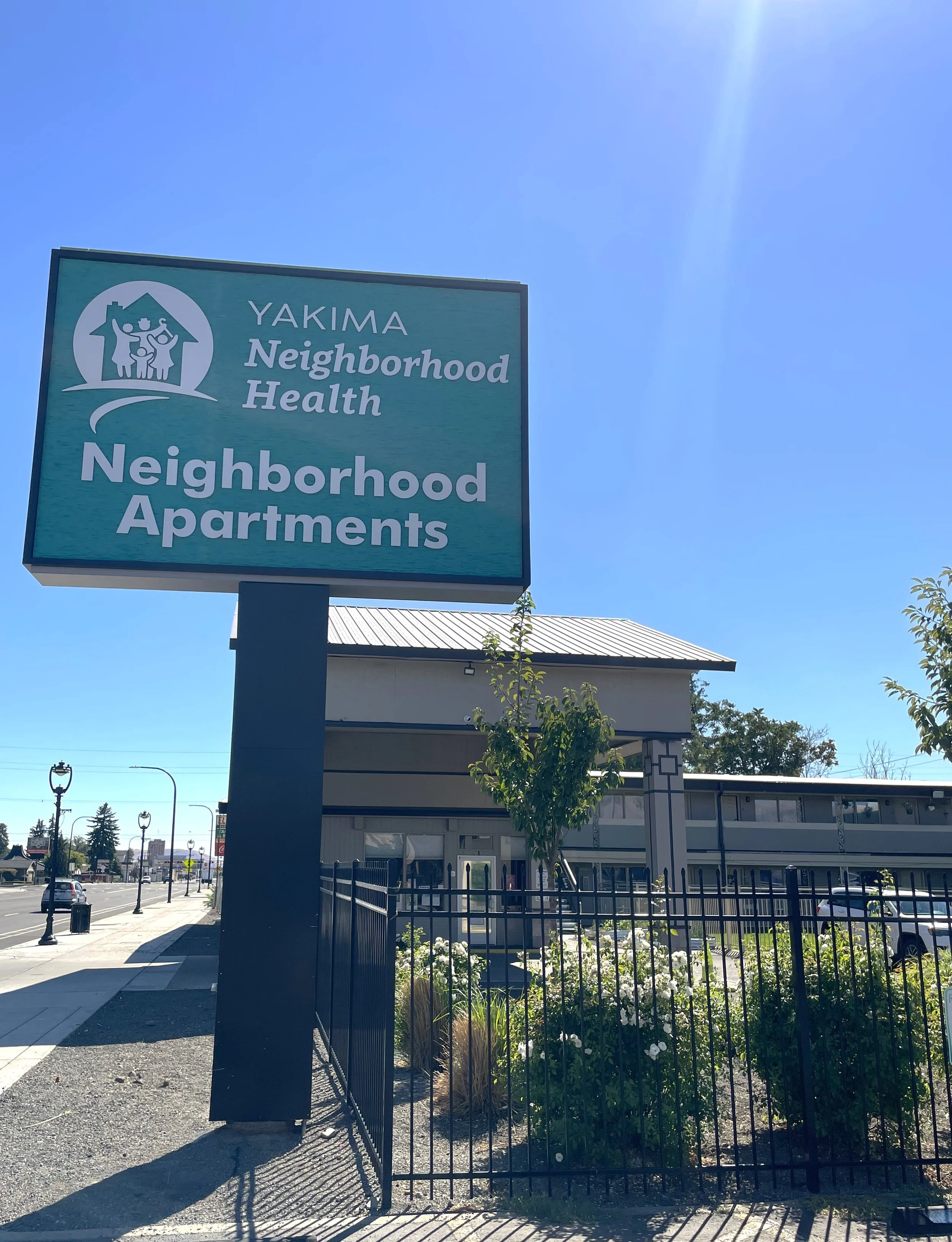
Neighborhood Apartments, pictured here, is a permanent supportive housing development owned and operated by Yakima Neighborhood Health Services.
For most, a motel is a temporary stop away from home – the original respite for road trippers across the country. In recent years, out-of-commission motels have found new life as permanent supportive housing for communities facing a lack of resources to assist the chronically homeless or disabled. Two such examples already exist in Yakima, both owned and operated by Yakima Neighborhood Health Services.
In 2022, Yakima Neighborhood Health Services hired ORFH to help acquire the 1st Street motel formerly known as the Yakima Valley Inn. The funds used for the $2.7 million acquisition had been set aside by the State to support such projects, and the 58 units the former inn would add in support of housing for those experiencing homelessness was “a significant number for the town of Yakima,” said Doug Bommersbach, Housing Developer at the Office of Rural and Farmworker Housing (ORFH).
The development of more permanent supportive housing in Yakima was a crucial element of the homeless response led by Neighborhood Health.
“We delved into the world of housing because we recognized that housing is an essential component to improving people's health,” said Rhonda Hauff, CEO of Yakima Neighborhood Health Services. “And when we had the opportunity to reach out to our unhoused populations, we recognized that in order to contribute to the dearth of housing, that we needed to – that we could contribute to that by getting into becoming supportive housing providers ourselves.”
ORFH and Neighborhood Health first partnered in 2010 on what is now known as the Rhonda D. Hauff Resource Center, a former supermarket on Sixth St. that provides temporary housing and services for the homeless. The partnership continued for the Yakima Valley Inn project, now known as Neighborhood Apartments.
Bommersbach, who came onto the project in the middle of construction, noted that the existing structure did bring its own set of challenges.
“The challenges were just, you know, it was kind of overwhelming that it’s an old motel and it needed a lot of upgrading,” Bommersbach said. “But they [Neighborhood Health] did a good job on tackling all those issues and getting it improved quite a bit.”
Upgrades included fixing a leaky roof, mending flood damage and adding insulation, security features, landscaping and more. Some of the improvements are ongoing, as just this year more funding was approved by Washington State’s Housing Preservation Program.
“… I’m just waiting for [the Department of] Commerce to give me the go ahead to close on this and get going on this – it’s kind of a limited scope of work it’s just the stairs, roof and the gutters but it will make a big difference in the envelope of the building and protect everything,” said Bommersbach.
With the successful renovation of Neighborhood Apartments under their belt, Neighborhood Health quickly made plans for another permanent supportive housing project, using the same model – purchasing and updating a former motel.
The former Motel 6, located on Staff Sgt. Pendleton Way, was acquired in early 2024. The building offers 39 units for permanent supportive housing, 20 of which were earmarked for young adults ages 18 – 24. The location also includes support from onsite case managers to connect residents with various health and social services. Improving the health and self-sufficiency of those they serve has long been a priority for Neighborhood Health.
“…We have a strong team who are well-trained in trying to reduce barriers and promote improved health and strengthening vocational training and employment possibilities,” said Hauff.
At Motel 6, now known as Vecino Apartments, additions were made to the structure to support the services offered and to help encourage community engagement. A community center was built on the property, complete with a new kitchenette.
“So, they have a beautiful kitchen with a nice open view, a nice [kitchen] island. The community space has all these… tables for people to gather and eat,” said Jose Farias, Housing Developer with ORFH. “There’s also 3 offices for any kind of case management that needs to happen. We did provide a playground because we are serving families with children, so they got an awesome playground,” said Farias
Although renovating these existing structures comes with its challenges, namely a fierce competition for funding, Neighborhood Health has no plans to stop anytime soon.
“We’re hopefully going into a new project very soon and you know, renovating existing buildings, which tends to be what we do well,” said Hauff.
Despite the challenges, the success stories are numerous, and those provide the lasting impact that keep Neighborhood Health, and ORFH, invested in the work.
“That’s just it [what has had the biggest impact], is hearing the success stories from our staff,” said Hauff. “And the other thing I would say is seeing the reduced number of unhoused people in our community – this is our community, and we have fewer people on the streets and that has had a huge impact on me.”